Team
We assessed our strengths!
We assessed our strengths! Yes. It helps organizations get the very best out of their people — accelerating business strategies and creating an inclusive, collaborative and fulfilling work experience.
This is not the first time we do this assessment, since our team has shrunk in the last year, we thought it would be beneficial to repeat it. A team of three can operate as a highly efficient, cohesive unit where each member’s unique contributions are maximized, leading to better outcomes and a more positive work environment.
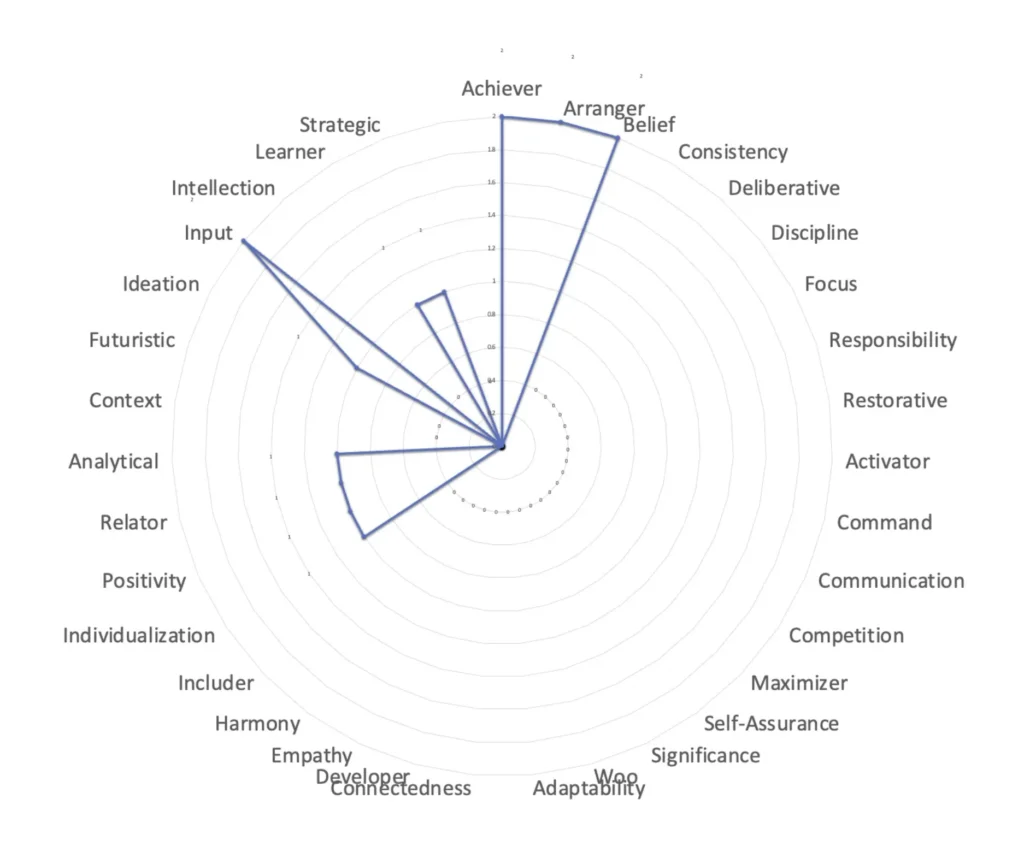
Here are our results! Overall, this profile positions the team as a high-performing unit for strategic execution in a collaborative setting, with clear advantages in productivity and innovation. By leveraging these insights, the team can optimize contributions, address blind spots, and create a more inclusive, effective work experience.
Key Insights
- Dominance in Executing and Strategic Thinking Domains The team is heavily weighted toward Executing (with Achiever, Arranger, and Belief appearing multiple times) and Strategic Thinking (with Ideation, Input, Strategic, Analytical, and Learner). This suggests a group that’s highly productive, organized, and analytical. On the strategic side, the team can generate creative ideas, collect valuable information, and analyze data logically. This combination makes the team ideal for roles involving planning, problem-solving, and efficient execution, such as project management or innovation initiatives.
- Moderate Focus on Relationship Building The team has solid foundations for internal cohesion and motivation. Positivity infuses enthusiasm and optimism, helping maintain morale during challenges. Individualization allows for tailored approaches to people, which is useful in a small team for understanding unique needs. Relator fosters deep, trusting relationships, promoting collaboration. However, this domain is less dominant than others, so the team may excel more at internal dynamics than at expanding networks externally.
- Absence of Influencing Themes Notably, there are low Influencing strengths in the team. This could be a blind spot, as the group might struggle with persuading stakeholders, or promoting ideas publicly. While their executing and strategic strengths ensure solid delivery, we may need to consciously develop skills in advocacy or seek external support for negotiations, or presentations to avoid being overlooked.
- Complementary Dynamics in a Small Team The strengths align well for synergy: Glenisse’s Strategic and Ideation pair with her Achiever drive to lead on visionary tasks, while her Positivity keeps the energy high. Richard’s Analytical and Individualization complement his Executing themes, making him great for customizing plans and ensuring quality through data-driven decisions. Virginia’s Learner and Input enhance her Relator and Executing strengths, positioning her as a knowledge gatherer who builds bonds through shared learning. In a team of three, this creates a balanced loop—strategic planning feeds into organized execution, supported by positive relationships—leading to efficient, adaptive performance without much overlap or conflict.
- Potential for High Productivity and Innovation With two Achievers and multiple strategic thinkers, the team is poised for consistent output and creative problem-solving. For example, Beliefs (Richard and Virginia) provide a values-driven anchor, ensuring efforts align with core principles, while Learners (Virginia) and Inputs enable continuous improvement through knowledge accumulation. This could accelerate business strategies, as the team absorbs information quickly (Strategic Thinking) and turns it into action (Executing), fostering a fulfilling work environment where contributions feel meaningful.
- Risks of Over-Reliance on Analysis or Internal Focus The emphasis on Strategic Thinking might lead to over-analysis or “paralysis by planning” if not balanced with decisive action—though the strong Executing domain mitigates this. Similarly, the lighter Relationship Building could mean the team prioritizes tasks over people, potentially causing burnout if morale dips. In a shrinking team, this profile supports resilience but highlights the need to monitor interpersonal dynamics closely.
- Opportunities for Growth and Role Alignment To maximize potential, assign roles based on strengths: Glenisse could handle ideation and strategy sessions, Richard focus on analysis and arrangement, and Virginia lead learning initiatives or relationship-focused tasks. Personalized development might involve training in Influencing skills (e.g., communication workshops) to address gaps. Repeating assessments periodically, as the team has done, will help track evolution and maintain cohesion.
To Learn more and do your own assessment: Access Gallup
Assessing the strengths of a team offers several benefits, particularly in optimizing team performance, collaboration, and productivity. Here are the key advantages:
- Enhanced Role Alignment: Identifying each employee’s strengths allows you to assign tasks and responsibilities that align with their skills and expertise. This ensures that each team member is working on tasks where they can excel, leading to higher efficiency and quality of work.
- Improved Collaboration: Understanding individual strengths fosters better teamwork by clarifying how each member’s abilities complement others. For a small team of three, this can create a balanced dynamic where each person’s contributions are valued, reducing overlap or conflict.
- Increased Productivity: When employees work in areas of their strengths, they tend to be more engaged and efficient. This leads to faster task completion and higher-quality outputs, maximizing the team’s overall productivity.
- Boosted Morale and Engagement: Recognizing and utilizing employees’ strengths shows that their unique contributions are valued, which can increase job satisfaction, motivation, and confidence. In a small team, this can foster a positive and supportive work environment.
- Better Problem-Solving: A clear understanding of each team member’s strengths enables the team to approach challenges strategically. For example, one employee might excel at creative ideation, another at analytical thinking, and the third at execution, creating a well-rounded problem-solving unit.
- Efficient Resource Allocation: In a small team, resources are limited. Assessing strengths helps you allocate time, effort, and responsibilities effectively, ensuring no one is stretched beyond their capabilities or underutilized.
- Personalized Development Opportunities: Identifying strengths also highlights areas for growth. You can tailor training or development plans to enhance existing strengths or address gaps, fostering individual and team growth.
- Stronger Team Cohesion: Discussing and appreciating each other’s strengths builds trust and respect among team members. In a team of three, where interpersonal dynamics are critical, this can lead to stronger relationships and smoother collaboration.
- Adaptability to Challenges: Knowing each employee’s strengths allows the team to adapt quickly to new tasks or challenges by leveraging the right person for the job, minimizing delays or missteps.
- Clearer Communication: When team members understand each other’s strengths, they can communicate more effectively, tailoring their approach to suit each other’s working styles and preferences.